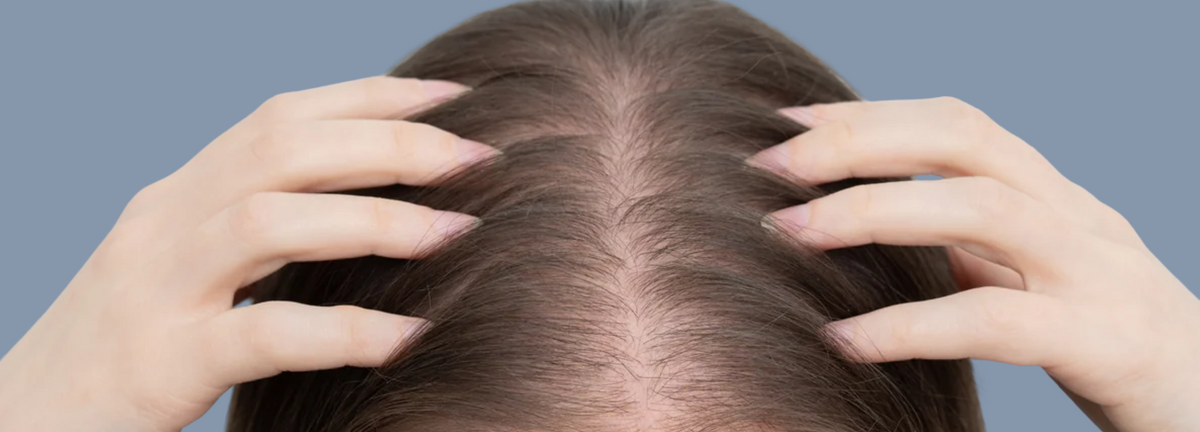
Why Is My Hair Thinning? Common Causes in Women
Medically reviewed by Dr. Kate Healy, MB BCh BAO, MICGP, CFPC – 2026-10-09
Thinning hair in women most often comes from female pattern hair loss, a period of heavy shedding after a trigger such as childbirth or illness, or a combination of the two. Less often, it reflects patchy hair loss, breakage or a scalp condition. Working out which is present matters, because some causes settle on their own while others need treatment or medical investigation.
If you are asking why your hair is thinning, you are probably trying to work out whether this is temporary, whether something is wrong, and whether it is worth seeing someone. The clues are in how the hair loss looks and when it started. Merrion's page on hair loss and thinning hair treatment explains how assessment and treatment follow from those clues.
Shedding or thinning? How the common causes differ
| Cause | What you may notice | Typical timing | Usual next step |
|---|---|---|---|
| Female pattern hair loss | Gradual thinning over the crown; a widening part; finer, shorter hairs | Develops over months to years | Assessment to confirm the pattern and discuss options |
| Telogen effluvium (shedding after a trigger) | More hair in the brush, shower or on the pillow, all over the scalp | Often starts about three months after a trigger | Identify and address the trigger; it often settles with time |
| Alopecia areata | Smooth, round bald patches; sometimes eyebrows or lashes | Can appear suddenly | Medical assessment |
| Traction or breakage | Short, broken hairs; thinning at the hairline or where hair is pulled tight | Builds up with styling over time | Gentler styling and hair care |
| Scalp conditions and scarring hair loss | Itching, burning, tenderness, redness, scaling or shiny patches | Variable | Prompt medical assessment |
Mixed patterns are common: a period of shedding can make underlying pattern thinning more obvious. This table is a starting point for discussion, not a way to diagnose yourself.
Female pattern hair loss
Female pattern hair loss is the most common cause of gradual thinning in women.[2] Hair follicles in affected areas slowly produce finer, shorter hairs, so the part widens and more scalp shows over the crown. The frontal hairline is usually preserved, which is one way it differs from the pattern often seen in men.
A family history of thinning suggests a possible inherited predisposition, and hormonal changes can play a part. It can start at any age after puberty and often becomes more noticeable around menopause. Pattern hair loss tends to progress slowly over time, which is why treatment is usually aimed at slowing it and supporting density.
Hair shedding after a trigger: telogen effluvium
Telogen effluvium is a temporary increase in shedding. A physical or hormonal stress pushes more hairs than usual into the resting phase at once; those hairs then shed, typically about three months later, although the gap can range from one to six months.[1]
Common triggers include:[1]
- childbirth
- illness with fever, severe infection, surgery or major physical trauma
- crash dieting or low protein intake
- iron deficiency
- an underactive thyroid
- stopping an oestrogen-containing medicine
- some medicines, including certain blood pressure medicines, retinoids and anticoagulants
Once the trigger is identified and corrected, shedding usually settles. Regrowth can take several months to begin and up to a year to become noticeable.[1] Shedding that continues well beyond six months deserves a closer look for an ongoing cause.
Postpartum hair loss
During pregnancy, many women notice their hair feels thicker. After birth, falling oestrogen levels release more hairs into shedding, so postpartum hair loss commonly begins a few months after delivery.[1] For most women, it settles without treatment over the following months.
It is worth being assessed if shedding continues beyond your baby's first birthday, if you notice a widening part rather than diffuse shedding, or if you also feel unusually tired, cold or low, which can point to iron or thyroid problems. Many hair loss treatments are not suitable while breastfeeding, so seek individual medical advice before starting any.
Stress and hair loss
A period of significant physical or emotional stress can trigger telogen effluvium.[1] The shedding usually appears two to three months after the stressful event rather than during it, which is why the link is easy to miss. Stress should not be assumed to explain every case of thinning, though: blaming stress alone can obscure a separate, treatable cause, particularly when thinning is gradual or the scalp is uncomfortable.
Iron deficiency and thyroid problems
Low iron and an underactive thyroid are both recognised contributors to hair shedding.[1] Blood tests can check iron levels and thyroid function. They are chosen to answer a specific question raised by your history and examination, rather than ordered as a broad panel. A normal result on one iron test does not always rule out deficiency, so tests are interpreted together with your history.[1]
Menopause and hair thinning
Around menopause, falling estrogen levels can make pattern thinning more noticeable, and some women also notice changes in hair texture. Thinning at this stage is often gradual rather than sudden. Sudden heavy shedding around menopause is worth checking for another trigger, such as iron deficiency, thyroid change or a new medicine.
Other causes to be aware of
- Alopecia areata causes round, smooth patches of hair loss and needs medical assessment.
- Traction and breakage come from tight hairstyles, extensions, heat and chemical treatments. Changing styling habits early matters, because long-standing traction can become permanent.
- Scalp conditions and scarring hair loss may cause itching, burning, tenderness, redness or scaling. Some forms can permanently damage follicles if untreated, so they need prompt assessment.
When to have your hair loss assessed
Seek assessment promptly if hair loss is sudden or patchy, if eyebrows or lashes are affected, if your scalp is painful, itchy, red, scaly or shiny, or if you feel unwell. It is also reasonable to be assessed if gradual thinning has continued for several months or is affecting how you feel.
It helps to think through a few questions beforehand. When did you first notice the change? Was there an illness, a birth, significant weight loss, a new medicine or a difficult period a few months earlier? Is the part slowly widening over years, or has shedding increased suddenly? Is the scalp itchy, sore or flaky?
During an assessment, Dr. Kate considers when the hair loss began, recent events, family history, menstrual and menopausal changes, medicines, diet and styling habits, and examines the scalp. Depending on the history, blood tests may be suggested, or a referral, including to a dermatologist, may be appropriate.
What may help once the cause is known
Shedding after a trigger usually improves once the cause is addressed. For female pattern hair loss, options a physician may discuss include topical minoxidil,[3] prescription medicines selected individually, and scalp microneedling, which has the strongest evidence when combined with minoxidil.[4] Our article on microneedling for hair loss explains that evidence, and our comparison of hair loss treatments sets out how the options differ.
For pattern thinning on a healthy scalp, Merrion's Hair Growth Microneedling Program is one option to discuss after assessment.
Organise your concerns before a visit. The quiz helps you describe what you notice; it does not replace an examination.
To understand what is behind your thinning hair, book a complimentary consultation with Dr. Kate.
Frequently asked questions
Why is my hair thinning on top?
Thinning over the crown with a widening part is typical of female pattern hair loss. Diffuse shedding can also make the top look thinner, so an assessment helps to tell them apart.
Can stress cause hair thinning?
Yes. Significant physical or emotional stress can trigger a period of shedding, usually appearing two to three months later. It often settles once the stress has passed.
Can low iron cause hair thinning?
Iron deficiency is a recognised contributor to hair shedding. Blood tests can check iron levels, and results are interpreted alongside your history.
Is postpartum hair loss permanent?
Usually not. Postpartum shedding commonly settles over the months after birth. If it continues, or a widening part develops, an assessment is worthwhile.
Will hair thinning from menopause grow back?
Pattern thinning that becomes more noticeable around menopause tends to persist without treatment. Shedding from another trigger at this stage may settle once the cause is addressed.
How much hair shedding is normal?
Losing some hair every day is normal. Noticeably more hair than usual over several weeks, especially after a trigger, suggests shedding worth discussing.
Sources
- Hughes EC, Syed HA, Saleh D. Telogen effluvium. StatPearls. Updated 2024.
- Phillips TG, Slomiany WP, Allison R. Hair loss: common causes and treatment. Am Fam Physician. 2017;96(6):371–378.
- Dakkak M, Forde KM, Lanney H. Hair loss: diagnosis and treatment. Am Fam Physician. 2024;110(3):243–250.
- Gupta AK, et al. Relative effects of minoxidil 5%, platelet-rich plasma, and microneedling in pattern hair loss: a systematic review and network meta-analysis. Skin Appendage Disord. 2023;9(6):397–406.
This information is educational and does not replace personalised medical assessment.